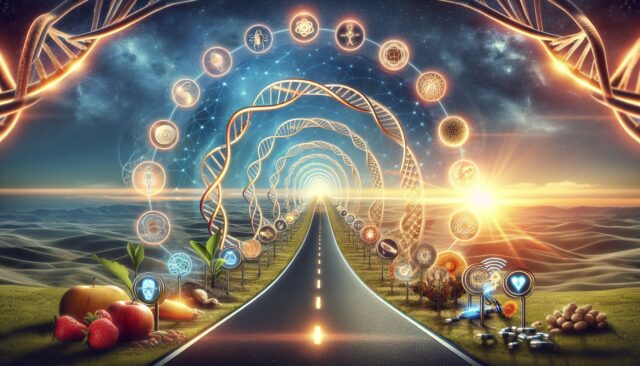
Welcome back, fellow tech adventurers! Let’s talk about a subject that’s been hovering in our collective minds, kind of like a persistent pop-up ad in your brain’s browser: Longevity. The quest to extend human life isn’t a new one. From Ponce de León’s fabled Fountain of Youth to modern-day cryogenics and telomere research, the dream of living longer—and dare we say, healthier—lives continues to captivate our imagination. Today, we’re looking at the latest developments in longevity research that are transforming headlines into actual possibilities.
The Science of Living Longer
Before we explore the startups and starry-eyed scientists, let’s first break down the scientific ideas driving longevity research. At the core, we’re trying to tackle the aging process. Aging, in scientific parlance, involves a lot of beaker-busting factors: cellular senescence, telomere shortening, DNA methylation, and mitochondrial dysfunction, among others. Remember when these terms were only fodder for biology PhD students and sci-fi writers? Not anymore. These are now mainstream terms thanks to the incredible pace of technological development.
Cellular Senescence: Arresting the Arrest
One of the fast-emerging avenues targets cellular senescence. Simply put, cellular senescence is what happens when cells stop dividing. They do this when they’ve reached the Hayflick limit (usually around 50 divisions). But here’s the kicker—these senescent cells refuse to die quietly. They give off a chemical scream that ratchets up inflammation and mess with nearby cells.
Startup companies are stepping in with innovative solutions to target these aged cells. Unity Biotechnology, for instance, is zeroing in on drugs that could remove senescent cells. Their clinical trials are as closely monitored as a viral cat meme, and results so far have been promising.
Telomere Lengthening: No, It’s Not Just About the Tips
What about telomere lengthening? Telomeres are the caps at the end of our DNA strands. With each cell division, they get shorter, unraveling like a mix tape rewound one too many times. Eventually, cells hit the eject button on dividing (leading us back to cellular senescence). Some labs are trying to figure out if extending telomeres can extend life yet another leap. Liz Blackburn, who won the Nobel Prize for her work, co-founded a company called Telomere Health that’s hot on this trail.
Tech Startups: Battling Age with Code and Capital
Tech startups abound in the longevity space, often showing the audacity and tenacity needed to storm the gates of biology. Companies like Calico Labs, a Google Alphabet spinoff, lead the charge with hefty billion-dollar bank rolls that could bankroll moon missions. They’re in it for the long haul, from expensive tech-campus R&D to using Big Data algorithms that could predict cellular deterioration decades before you need a walking stick.
AI and Big Data: The Algorithms of Eternal Youth
Artificial Intelligence isn’t just ChatGPT spinning yarns at cocktail parties. Machine learning models are being tuned to unprecedented precision to make sense of a mind-boggling array of biological data. AI does a Sherlock Holmes impression, analyzing DNA sequences, blood markers, and MRI scans to predict longevity, potential health risks, and anomalous trends before they become crises.
A startup worth your attention here is Insitro, which uses AI like a scalpel to solve biological puzzles. Using algorithms trained on massive datasets, they’re aiming to make diagnostic predictions faster than Bruce Wayne changing into Batman. Their mission: fast-track drug discovery to fight age-related diseases.
The Role of CRISPR and Gene Editing
And then there’s CRISPR, the Cas9 editing tool that treats DNA like Microsoft Word treats misspelled words. The idea is revolutionary—snip, edit, and potentially fix genetic mutations directly at the source.
Ethical Conundrums and Scientific Quandaries
Of course, messing with the building blocks of life opens a Pandora’s box of ethical questions. Is it okay to engineer ‘designer babies’? Do we risk deepening socioeconomic divides if the wealthy are the only ones who can afford genetic editing? Don’t expect easy answers. But the conversations are as necessary as they are controversial.
The Interdisciplinary Approach: It’s More Than Just Biology
Longevity research isn’t just squabbles between geneticists and biotech specialists. It’s a mix of cross-discipline expertise. Biomedical engineering, material science, pharmacology, sociology, and even data security contribute to creating a framework where people might one day celebrate a 200th birthday without looking like a shriveled raisin.
Materials Science is jumping in, helping create biocompatible materials that can work with organic tissues. These materials could help regenerate degenerated tissues or even create new neurons.
The Road Ahead: When Do We Pop The Champagne?
So, are we on the brink of living like ageless elves from Tolkien’s Middle-earth? Not quite. But the roadmap is expanding, and the lanes are becoming increasingly well-defined. We see hints of promise in each scientific paper, each successful clinical trial, and every algorithm that’s trained to predict life spans.
Challenges to Consider
But before you stockpile anti-aging serums that you’ll bury in the back of your bathroom cabinet, know this: hurdles remain. Governments and regulatory bodies move slower than dial-up internet, ethical challenges demand thoughtful debate, and the science itself is notoriously complex. But small victories add up. Each baby step—each telomere lengthened, each senescent cell neutralized—contributes to the broader narrative that maybe, just maybe, the dreams of our ancestors weren’t just pipe dreams after all.
Conclusion: A Tech-Savvy Tomorrow
We’re living through the dawn of a new era where pixels touch DNA, AI deciphers life cycles, and genes are rewritten like code. It’s technology translating the Shakespearean ‘seven ages of men’ into a post-modern ‘several ages,’ or even ‘centuries, possibly.’
So, gear up, because the journey is far from over. Whether you’re ready to embrace techno-utopian ideals or remain skeptically perched on the fence with a cat (alive, thanks to Schrödinger), one thing is clear: longevity is no longer science fiction. It’s an emerging science fact—a field ripe for disruption, ethical evolution, and societal transformation.
Until next time, keep those synapses firing and your imagination stirred. Here’s to the age of longevity—and, fingers crossed, a future where blowing out 150 candles on a birthday cake becomes, literally, the new normal. Keep dreaming, keep questioning, and keep growing… but, you know, slower now.