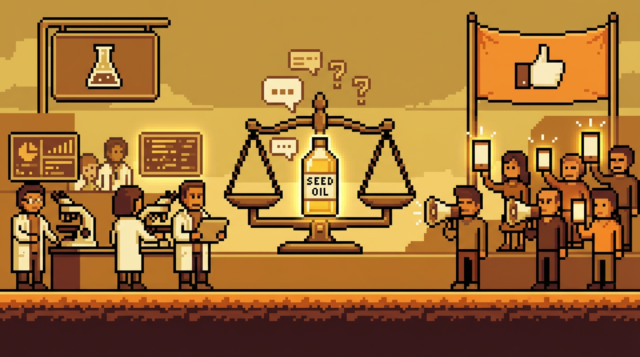
The Year the Seed Oil Debate Got Official
Let me be direct with you: 2025 was the year this conversation stopped being something people whispered about in CrossFit gyms and actually landed on the FDA’s desk. When Robert F. Kennedy Jr. took on the role of HHS Secretary, he brought with him a very public position that seed oil consumption drives chronic disease. The FDA responded by commissioning a formal literature review. This wasn’t a dismissal. This was institutional acknowledgment that the question deserved rigorous examination.

Here’s what I want you to understand before we go any further: institutional attention doesn’t mean the science shifted dramatically overnight. What it means is that influencers selling you clay that supposedly absorbs seed oils, or peddling $45 bottles of “ancestral fat,” now have political wind at their backs. They’re using the word “official” a lot. They’re implying that the government finally admitted they were wrong about seed oils all along. This is where we need to slow down and actually read what the research is saying versus what people are selling you.
I spend a lot of time in restaurant kitchens, watching how food actually gets made at scale. I’ve learned that the most honest conversations happen when you acknowledge what’s genuinely uncertain while also respecting what decades of data have already shown us. The seed oil story is neither simple nor settled. But it’s also not as scandalous as TikTok is suggesting.

What the 2025 Research Actually Demonstrates
A comprehensive meta-analysis published in the American Journal of Clinical Nutrition in 2025 examined 30 randomized controlled trials. The finding: replacing saturated fats with linoleic acid-rich oils reduced cardiovascular risk by roughly 17 percent. Sit with that number for a moment. Seventeen percent is significant enough that your cardiologist would notice. It’s not dramatic enough that you should panic if you’re using canola oil to sear your chicken.
The Framingham Heart Study, which has been following the same population for generations now, continues to show that polyunsaturated fat intake looks protective compared to saturated fat intake. This data is still being cited, still holding up. That matters. It means we’re not looking at a reversal of scientific consensus. We’re looking at, at minimum, a lateral move in how we think about these oils, and possibly a continued advantage for them over traditional saturated fats.
What makes this complicated is that showing one thing is better than another thing doesn’t automatically mean the first thing is optimal. The research tells us that seed oils appear to be better for heart health than butter or lard, all else equal. It doesn’t tell us that seed oils are the pinnacle of human nutrition. Those are different conversations. Influencers often collapse them into one another.
The Reality of What Americans Are Actually Eating
According to the USDA Economic Research Service Oil Crops Data, canola oil, soybean oil, and sunflower oil together represent approximately 72 percent of all edible oil consumed in U.S. food service. That’s not a conspiracy. That’s economics. These oils are cheap, shelf-stable, have high smoke points, and perform predictably in commercial kitchens. When you eat french fries at a chain restaurant, when you buy bakery items from a grocery store, when you order soup at a café, you’re consuming these oils.
I’m going to tell you something that the supplement industry doesn’t want you to know: most Americans aren’t making a conscious choice about seed oils at all. We’re consuming them passively through processed foods and restaurant meals. The conversation about whether seed oils are good or bad almost entirely misses the actual problem, which is that they’re everywhere in foods that are often poor quality to begin with. You’re not getting sick because your olive oil was cut with soybean oil. You’re getting sick because you’re eating ultra-processed food that happens to contain soybean oil.
When you cook for yourself at home, you have agency. You can use olive oil, avocado oil, or coconut oil. You can choose butter. You can make intentional decisions. This matters far more than any individual oil’s chemical properties. The people most affected by the seed oil situation are not boutique home cooks reading food blogs. They’re people eating whatever food is affordable and available, which happens to be heavily seed-oil dependent.
The Marketing Machine Behind the Alternatives
Let me tell you what’s genuinely shifted: tallow and lard sales. Between 2023 and 2025, specialty butchers and online retailers saw an estimated 60 percent growth in these products, driven primarily by carnivore and ancestral diet communities. That’s a real trend. It’s also a market opportunity, and markets have a way of encouraging narrative simplification.
When something becomes trendy, the marketing follows. You start seeing emotional language about our grandmothers’ cooking methods and ancestral wisdom. You see terms like “lipid hypothesis debunked” thrown around casually. You see before-and-after photos attached to oil choices. The narrative becomes: “They lied to us about fat, and here’s what really heals your body.” It’s compelling. It feels like insider knowledge. The problem is that it’s not supported by the weight of the evidence, even in 2025.
Don’t misunderstand me. I’m not saying lard and tallow are inherently bad. I’ve cooked with both. They have beautiful flavors and real culinary applications. Grandmothers did use them successfully. But that doesn’t mean that every modern cooking oil is toxic or that switching back to them will solve your health problems. The science on cardiovascular risk suggests otherwise.
How to Actually Think About This in Your Kitchen
Here’s my honest take after years of cooking and reading the actual literature: the seed oil debate has become a proxy for a larger anxiety about food systems and trust. You don’t trust that processed food is made with your health in mind. You shouldn’t. That’s valid. But the solution isn’t to reject seed oils categorically. The solution is to cook more food yourself, from whole ingredients, and use whatever fat makes sense for the dish.
If you prefer the flavor of butter for your vegetables, use butter. If you want olive oil for a vinaigrette, use olive oil. If you’re deep-frying something and canola oil is what you have, use canola oil. None of these choices will derail your health. What will actually impact your health is whether you’re eating mostly whole foods, moving your body regularly, sleeping enough, and managing stress. These factors will matter infinitely more than your oil choice.
The 2025 science doesn’t represent a dramatic reversal in how we should think about seed oils. It represents a call for continued research and a recognition that this deserves official attention. That’s intellectually honest. It’s also not sexy. It doesn’t sell expensive alternative products. I think you deserve the unglamorous truth more than you deserve a narrative designed to make someone money.
Let’s Keep This Conversation Going
What has your actual experience been in the kitchen? Have you noticed a difference in how you feel when cooking with different oils, or is this something you’ve never really thought about? I’d genuinely like to hear from you about what drew you to this question in the first place, because the people asking tend to be people who already care about food quality. That instinct is right. The conclusions you draw from caring about that quality don’t have to match what TikTok is telling you, though.