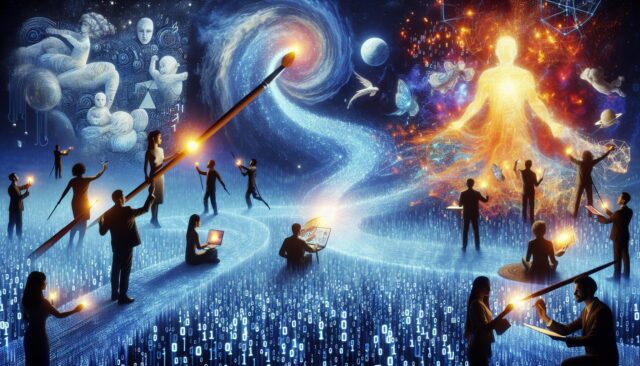
Hey tech trailblazers and AI aficionados! Ever sit at a canvas of possibilities, brush in one hand, and pure creativity in the other, only to wish the software could do most of the heavy lifting? Okay, maybe not all of us have. But let me tell you, there’s a revolution brewing in the world of creative arts, and it’s made entirely of zeros and ones. Let’s jump into the fast-paced universe of AI in the creative arts.
The Rise of AI in Art
Artificial Intelligence has always been something of a misunderstood artist, churning out data analyses like poetry and calculations like jazz solos. But lately, our pixelated prodigy is painting quite a different picture.
I remember a time when artists were apprehensive. The fear wasn’t that AI would outdo them, but that it would never understand them, like a grandparent trying to figure out TikTok. Fast forward to today, and AI’s gaining ground faster than my friend who decided to run marathons for fun. Take DALL-E 2 or Midjourney, for instance. These generative models turn text prompts into digital paintings faster than you can say “Bob Ross Bots.”
The Machines Can Paint… and Chill
So what exactly can AI do in the realm of arts? Well, think of it as an extraordinarily ambitious collaborator. It doesn’t tire or complain, and it definitely doesn’t need coffee breaks, unless software updates count. From generating abstract art that’d make Picasso proud to recreating famous works with an AI “twist,” it’s a new world of possibilities.
This shift isn’t just about painting either. We’ve got AI composing symphonies, writing novels, and even designing architecture. The potential applications are as vast as my unfiltered love for tech conferences.
Embracing Collaboration: Artists and Algorithms Unite
There’s good news for those of us who fear robots aren’t quite ready to take over the world (yet). This isn’t an “us versus them” scenario. It’s a glorious opportunity to remix, rework, and reimagine art in ways we’ve only dreamed of before.
Artists Find a New Brush
Experienced artists can now look at AI not as a competitor but as an extension of their paintbrush. No longer is it a struggle for originality, it’s fighting writer’s block with a concrete sledgehammer. Imagine being able to take an original piece of art and push its boundaries with an artificial accomplice, creating something beautifully unprecedented.
And the best part? Artists can spend more time focusing on core creative concepts while leaving the menial or painstaking tasks to their digital collaborators. Consider Adobe’s latest AI-centered tool that helps correct errors in photographs or assists in refining details. It’s a creative process rather than a substitution. Our own human creativity runs parallel to our silicon partners.
The Creative AI Problem
Alright, while it sounds like AI can do anything short of cook dinner, let’s talk about some challenges. AI-generated creativity is not without its critics, and for a good reason. There’s a lot AI can’t understand, namely, humans and our wildly emotional, irrational selves.
Creativity’s Cold Confines
An AI doesn’t know desire, longing, or the inexplicable giddiness when you finally finish a mammoth creative project. Some argue that this emotional detachment makes AI-generated art superficial or, at the very least, highly derivative. The counterargument is that even humans build on previously existing art, but at least we’ve got the emotional context (and a lot of coffee) underlining our versions.
On a more practical note, there are still issues with authenticity, copyright, and ownership when algos get artsy. Is a piece created by AI truly original? Can it be attributed to one coder’s brilliance? These questions tread murky legal waters and make what’s already a creatively complex terrain even slipperier.
Looking Ahead: What’s Next
Here’s where I let my optimism run wild, so hop aboard. This marriage between AI and the arts has only just begun its awkward first date, and I’m convinced the honeymoon period won’t be far behind. With current developments just scratching the surface, think of what could unfold in the next decade.
The Science-Fiction Awaits
Speculate with me for a second. Imagine an AI program that learns art technique as if it were a master and applies it across continents and cultures, continuously evolving like your favorite RPG character. Worldwide collaborations between AI systems and artists could result in the ultimate cultural melting pot, something both beautiful and profound.
Artists might specialize in dream pairing, fusing human vision with AI precision, themselves curators and orchestrators of a kind of ‘collective’ consciousness. You want to see Vincent van Gogh meet Afrofuturism with a splash of 90s grunge? AI might just make it happen.
In closing, AI and creativity isn’t about erasing the human or voiding our contributions. It’s like adding another, rather exciting media to our toolkit, akin to discovering you’ve been drawing with crayons and suddenly getting your hands on a whole box of professional-grade colored pencils.
AI and creativity? It’s a combo to be excited about. And those AI-generated sunsets? They’re pretty amazing, side note.
Thanks for tuning into my little corner of the techno-art world. Until next time, keep skipping through innovation fields, and may your algorithms always find the shortest path to creativity!
Stay curious,
Your Enthusiast Tech Blogger